
Using AI search optimization more explicitly keeps the topic closer to the real intent behind this subject and makes the opening easier to scan.
You spent three years climbing from position #8 to position #3. Congratulations—you might now be invisible.
For the last two decades, digital growth has felt like a ladder. You publish pages, you build links, you polish keywords, you climb. Even if you were not #1, you could still be “in the mix.” Position #3 still got clicks. Position #6 still got curiosity. And if your brand showed up on page one, you were at least invited to the consideration party.
AI search changes the party.
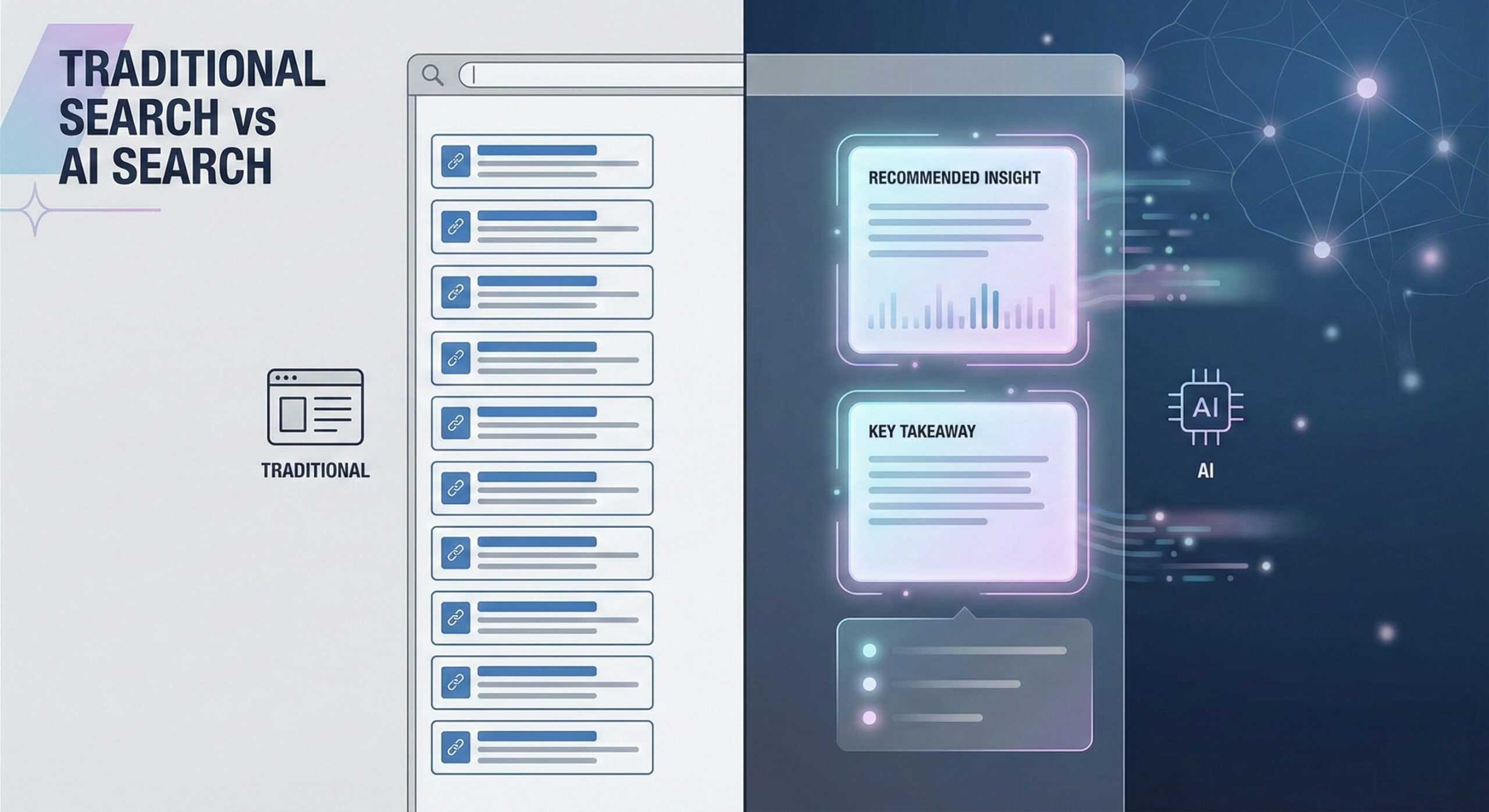
Most AI-led experiences don’t hand users ten blue links and say, “You decide.” They respond like a decisive assistant. They filter. They summarize. They recommend. Sometimes they give a shortlist, but it’s still a shortlist that the system chose. The core shift is not cosmetic. It is structural.
In AI search, being “ranked” is not the main game. Being selected for inclusion at all is the game.
And if you are not included, you are invisible.
How AI search optimization usually gets evaluated
Ranking Was a Spectrum. Selection Is a Gate.
Traditional search rewarded incremental improvements. Better SEO meant moving from page two to page one. Better content meant moving from #7 to #3. Those jumps mattered because users could scroll, compare, open multiple tabs, and form their own conclusion.
AI search compresses that behavior.
When someone asks, “What CRM should I use?” an AI system typically answers with a recommendation or a small cluster of options tailored to context—company size, budget, industry, and desired features. That response becomes the new first impression.
Instead of competing across a long list, you’re competing to be one of the few brands the AI considers “safe” and “relevant” enough to put in front of a user.
That is selection.
Ranking, if it happens, often becomes implicit. The first brand mentioned gets the halo. The others become supporting characters. The brands not mentioned might as well not exist.
This creates a winner-take-most dynamic instead of winner-take-more.
AI Is Not a Librarian. It’s a Decision-Maker.
The old model assumed search engines were organizers.
AI behaves more like a filter plus a translator plus a recommender. It tries to complete the task, not just point to sources. That means it is constantly making judgment calls:
Which brands are credible enough to mention?
Which ones match the user’s intent, not just the keyword?
Which options are simplest to explain in a short answer?
Which ones have enough public evidence to be confidently recommended?
If your brand cannot be confidently explained, it will often be excluded, even if it is technically a good fit.
This is where many businesses get blindsided. They think, “We have great SEO.” But AI selection is not only SEO. It is brand truth plus trust signals plus clarity.
The Hybrid Reality
This shift is real, but not absolute. AI can still offer multiple options. Traditional search already “selected” in practice because most clicks went to the top results. And many AI experiences still draw from indexed web content, reviews, forums, documentation, and publisher sites that were already ranking.
But directionally, the center of gravity is moving from “How high do we rank?” to “Do we get included in the answer set?” That difference is everything.
So How Does AI Decide Which Brands Get Selected?
Let’s simplify it into something usable.
AI systems tend to select brands that are:
1. Easy to Verify
If your claims cannot be cross-validated through multiple independent sources, you are a risk. AI prefers brands with consistent information across the web: product descriptions, pricing ranges, feature sets, customer reviews, press mentions, public documentation, and third-party listings.
Inconsistent data creates hesitation. Hesitation leads to exclusion.
2. Widely Referenced
Not famous in the follower-count sense. Referenced in a “this is a known entity” sense.
Think: review sites, analyst reports, credible blogs, industry comparisons, app marketplaces, integration directories, community threads, podcasts, and reputable publications.
Selection favors brands that show up in multiple places, in consistent context.
3. Trusted by People, Not Just Algorithms
Reviews matter more than most brands admit. Not because a 4.9 rating is magical, but because it is a public, human validation layer.
AI is trying to simulate good judgment. It leans on the public judgment of others.
4. Clear in Positioning
If your category is fuzzy, your messaging is vague, or your differentiation is buried in marketing poetry, AI struggles to place you.
The brands that get selected are often the ones that can be described in one clean sentence.
“X is best for Y, especially if you care about Z.”
That kind of clarity is machine-friendly and human-friendly.
5. Strong as an Entity
This is the part most marketers ignore.
AI doesn’t only read pages. It builds an internal map of entities: brands, people, products, categories, features, locations, and relationships between them.
If your brand looks like an entity with a clear footprint—meaning search engines and AI can connect your brand name to specific products, founders, features, and categories—you become easier to retrieve and recommend.
If your brand looks like a scattered set of pages with no consistent identity, you stay fragile.
What Selection Means for Your Marketing Strategy
This is the uncomfortable truth:
In the AI era, visibility is not about volume. It is about credibility density.
You don’t win because you posted 200 blogs. You win because when the model tries to answer a question, your brand shows up as a reliable pattern across the internet.
Here’s what that forces you to prioritize.
Build Trust Like It’s a Product Feature
Selection rewards trust signals that are hard to fake:
Real customer stories with specifics
Third-party coverage
Transparent pricing and clear packages
Documented integrations
Public-facing leadership presence
Consistent review velocity
Community proof: forums, Reddit, Slack groups, niche communities
Your website is not your only asset anymore. Your “web-wide reputation surface” is.
Stop Writing Content for Traffic. Write Content for Being Cited.
AI answers are built from language it can reuse. That means:
Define your category and your use cases plainly
Publish comparison pages that actually compare
Create “best for” and “not for” positioning
Provide frameworks, checklists, and decision criteria
Write documentation that explains outcomes, not fluff
If your content helps someone decide, it helps AI decide too.

Treat PR and Partnerships Like Discovery Infrastructure
Old PR was often a vanity play. Now it is a selection lever.
Getting mentioned in credible places increases the chances your brand becomes a “known known” in the model’s retrieval landscape. The goal is not press for ego. The goal is distributed credibility.
Make Your Brand Easy to Summarize
If an AI had to describe you in two sentences, could it?
Most brands fail this test because they try to sound impressive instead of being precise.
Precision gets selected.
The New KPI: “Share of Selection”
You will still track traffic. You will still care about conversions.
But a new measurement matters: how often your brand shows up in AI-generated recommendations for your category.
That might show up as:
Direct mentions in AI tools when users ask category questions
Increased branded search from people who “heard about you” via AI answers
More referrals from comparison and review ecosystems
More inbound leads who skip the awareness stage and show up pre-sold
This is the future of demand capture: not ranking for keywords, but being part of the answer.
A Practical Reset: How to Become Selectable
If you want a clean action plan, focus on these five moves:
Lock your positioning sentence. One line that says who you help, what you do, and what makes you the right fit.
Create proof assets. Case studies, reviews, integrations, demos, and third-party validation that can be referenced.
Build your entity footprint. Consistent brand info everywhere: bios, founder profiles, listings, documentation, and product descriptions.
Publish decision content. Comparisons, “best for,” use case guides, and pricing clarity.
Distribute credibility. Partnerships, guest features, podcasts, reputable directories, and community presence.
Because in AI search, the best brand does not always win.
The most trusted and verifiable brand does.
And that is the new visibility game: not climbing the ladder, but getting chosen at the door.