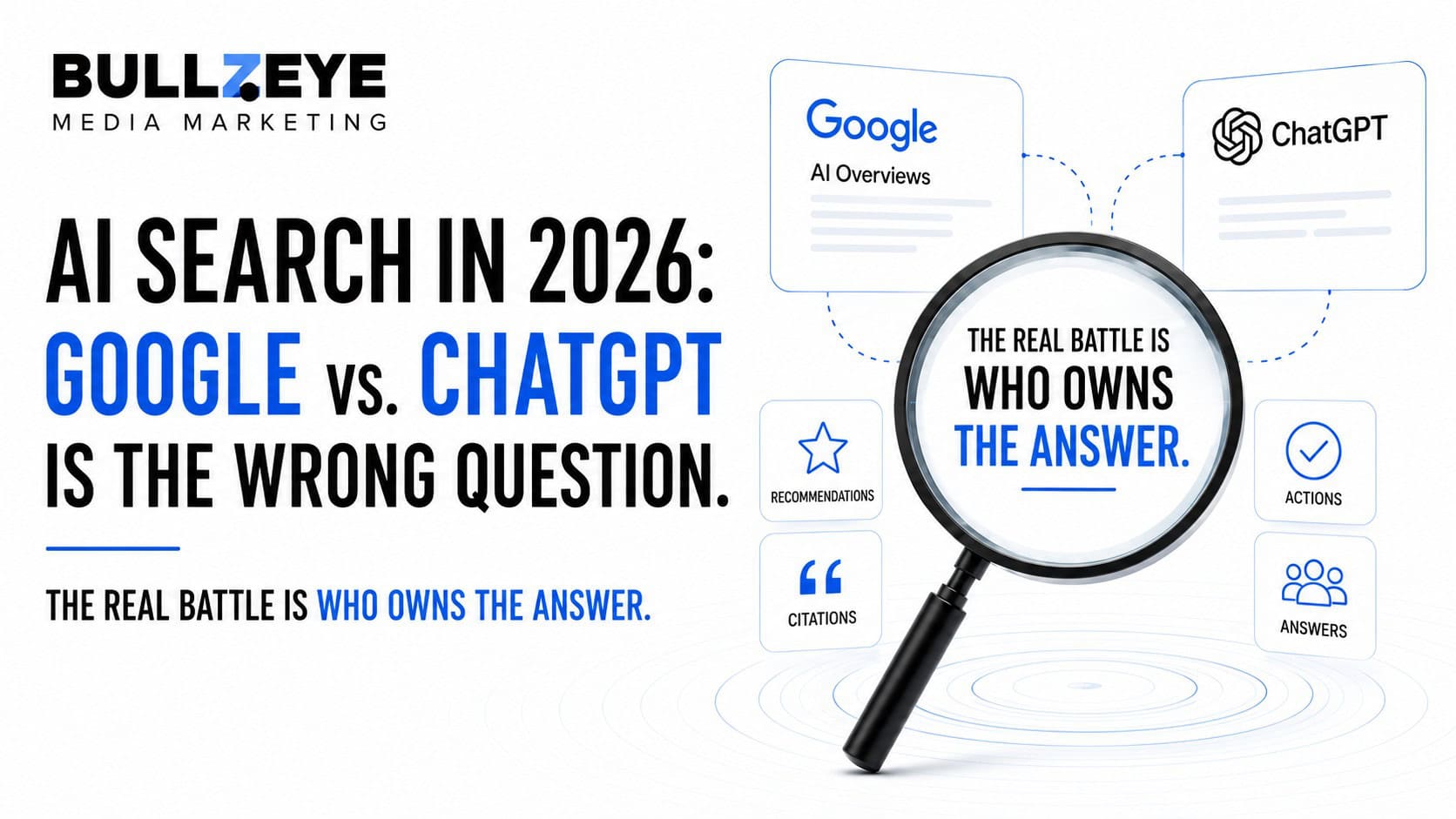
The most important question in search right now is not whether Google or ChatGPT will win. That question makes for an interesting prediction. It makes for a poor marketing strategy.
The real question for a CMO is much harder: When your customer asks an AI system what to buy, whom to hire, which company to trust or how to solve a problem, does your brand become part of the answer?
Because that is where search is moving. Not away from Google. Not entirely toward ChatGPT. Toward an environment in which discovery is fragmented across Google Search, Google AI Mode, AI Overviews, ChatGPT, Gemini, Perplexity, Claude, marketplaces, social platforms and eventually AI agents that do more than recommend. They will compare, shortlist and increasingly act.
Google says AI Mode has already surpassed one billion monthly active users globally, while AI Overviews has exceeded 2.5 billion monthly users. Google also reports that the average AI Mode query is about three times the length of a traditional search query. People are not simply typing different keywords. They are asking richer questions and delegating more of the research process to the interface. That changes the strategic problem.
For twenty years, marketers competed for ranking. Now they must compete for retrieval, interpretation, citation, recommendation and ultimately consideration. Those are not the same thing.
“The strategic mistake is asking which search platform will win. Your customer is already moving between platforms. The real question is whether your brand survives the handoff from search to synthesis to shortlist.”
— Meghna Deshraj, Founder & CEO, Bullzeye Media Marketing
The short answer: What is changing in AI search optimization?
AI search is compressing the traditional research journey. A conventional search might produce ten links. A user would open several tabs, read articles, compare companies, return to Google, refine the search and gradually build an opinion. Generative search can perform part of that synthesis before the user visits a website.
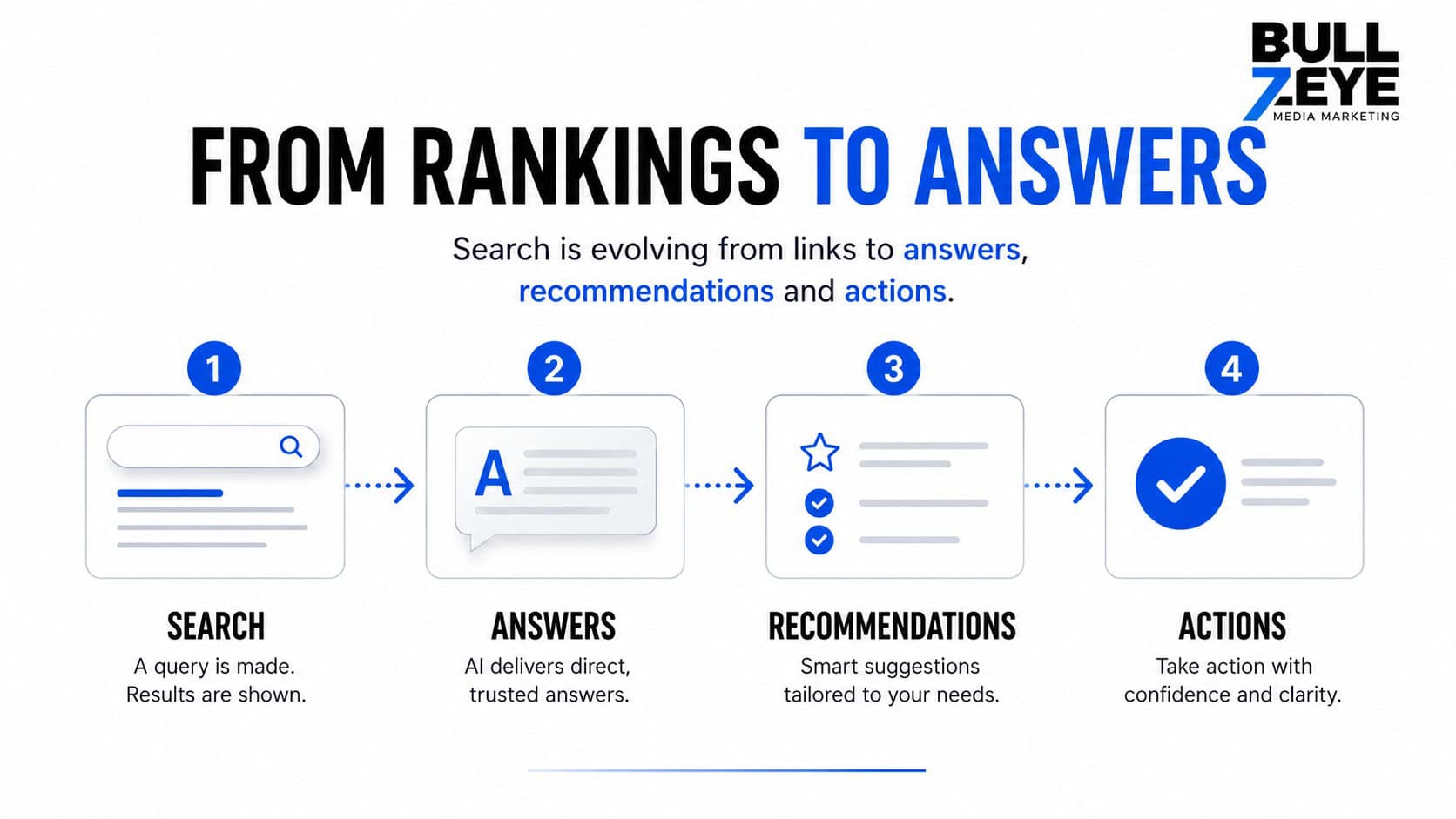
That distinction matters because a brand can now influence a buying decision without receiving the first click. Pew Research Center studied 68,879 Google searches and found a meaningful behavioral difference when an AI summary appeared. Users clicked a traditional search result in 8% of visits when an AI summary was present, compared with 15% when there was no AI summary. Links inside the AI summaries themselves were clicked in only about 1% of visits.
Ahrefs has found a similar directional effect. In its updated study of 300,000 keywords, the presence of an AI Overview correlated with a 58% lower click-through rate for the position-one organic result compared with the expected rate. That does not mean websites no longer matter. It means the website increasingly serves two audiences: the human buyer who eventually arrives, and the systems deciding whether the brand deserves to appear before that visit occurs.
This is why Bullzeye approaches SEO, AEO and GEO as connected disciplines rather than competing tactics. Read Bullzeye’s GEO vs. AEO vs. SEO framework.
Search traffic is declining in some places. Search influence is not.
This is the part many dashboards will miss. If someone searches for the “best cybersecurity platform for a 500-person healthcare company with HIPAA requirements” and an AI assistant summarizes five providers, your company may have already won or lost consideration before a session appears in Google Analytics. A zero-click interaction is not necessarily a zero-influence interaction.
That requires CMOs to separate three concepts that used to be closely connected:
- Visibility may produce an AI mention (rather than just impressions)
- Ranking may feed a generated answer (rather than just a click)
- Consideration may start before the click
Semrush analyzed 126 million U.S. AI search prompts across ChatGPT, Gemini, Google AI Mode and Google AI Overviews. Its findings show substantial differences in how platforms use sources and surface brands. ChatGPT averaged roughly 15 cited sources per response, while Gemini averaged around three.
SEO is not dead. It is becoming more foundational.
One of the more damaging narratives in the industry is that GEO is replacing SEO. It is not. Google’s July 2026 guidance says traditional SEO practices remain foundational to visibility in its generative search features. Google recommends technically accessible websites, unique and valuable content, and a good page experience.
Read Google’s official generative AI search optimization guidance.
There is no secret “GEO schema” that guarantees inclusion. In fact, a 2026 critical review covering 45 GEO-related studies concluded that generative visibility is a multi-stage process. Marketing teams do not need another black-box promise. They need an operating model built around what can actually be influenced and measured.
“GEO should not be sold as a magic ranking formula because no such formula has been proven. It is better understood as disciplined reputation, content and retrieval engineering around the systems now mediating discovery.”
— Meghna Deshraj
What actually makes content more citable?
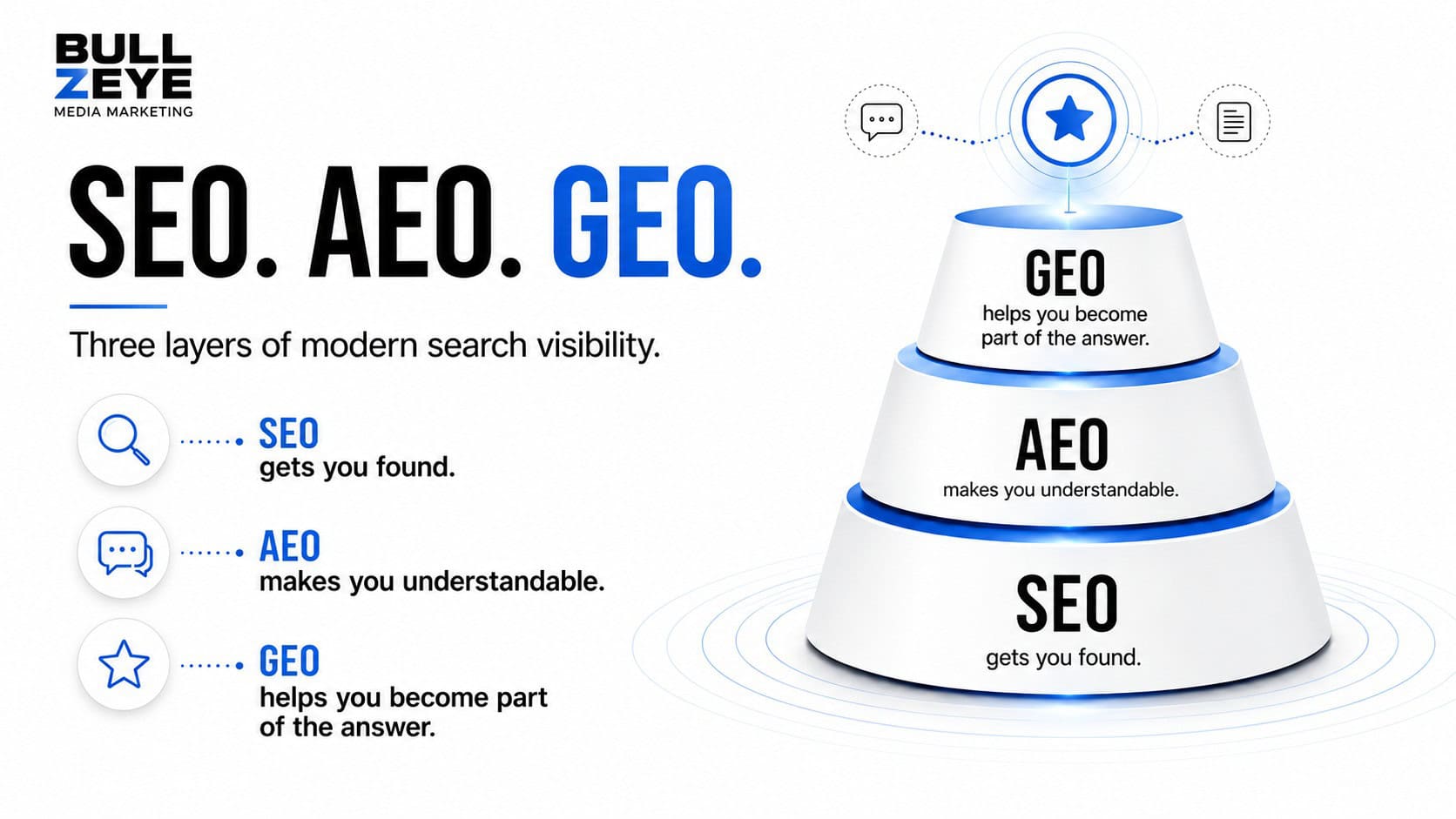
SEO helps you become retrievable. Your site must be crawlable and authoritative. Bullzeye’s traditional SEO services framework remains the foundation. AEO helps your expertise become understandable and extractable, while GEO expands the problem beyond your page—asking if enough consistent evidence exists for the machine to choose you. This is a core part of the Generative Engine Optimization service model.
Ahrefs analyzed 1.4 million prompts and found that semantic relevance between a page title and the system’s queries correlated strongly with citation. The practical conclusion is to build pages around actual subquestions that emerge during buyer research. Bullzeye’s analysis of content formats that earn AI citations reaches the same conclusion: the information need should determine the format.
What should CMOs measure now?
The measurement framework needs to evolve. Track brand mentions across relevant buyer questions, citation share, accuracy of brand representation, and AI referral traffic. Adobe Digital Insights reported that AI-referred retail traffic converted 42% better than non-AI traffic in March 2026. Review Adobe Digital Insights’ 2026 AI referral research.
Bullzeye’s AI Visibility Tool Evaluation Checklist goes deeper into why methodology and raw answer access matter when selecting measurement technology.
The Bullzeye 3D Framework: Differentiate, Disrupt, Dominate
At Bullzeye, we use the 3D Framework: Differentiate, Disrupt, Dominate. Differentiate by creating information worth retrieving—like proprietary data or expert analysis. Disrupt by structuring that information for modern discovery, and Dominate by building evidence beyond your website through digital PR and third-party authority. Explore Bullzeye Media Marketing’s strategy.
Frequently Asked Questions
What is AI search optimization?
AI search optimization improves how a brand is discovered, cited, and represented in generative answer systems, building on traditional SEO foundations.
Does GEO replace SEO?
No. SEO remains foundational, as Google confirms traditional best practices support visibility in AI Overviews and AI Mode.
Is AI search traffic valuable?
Yes. Early 2026 data shows AI-referred traffic converts significantly better and shows higher engagement than traditional sources.