
These are not three strategies. They are three rings of one target, and the prize moved from the ranking to the citation. Here is what changed, what the data says, and where a CMO should put the budget.
The short answer
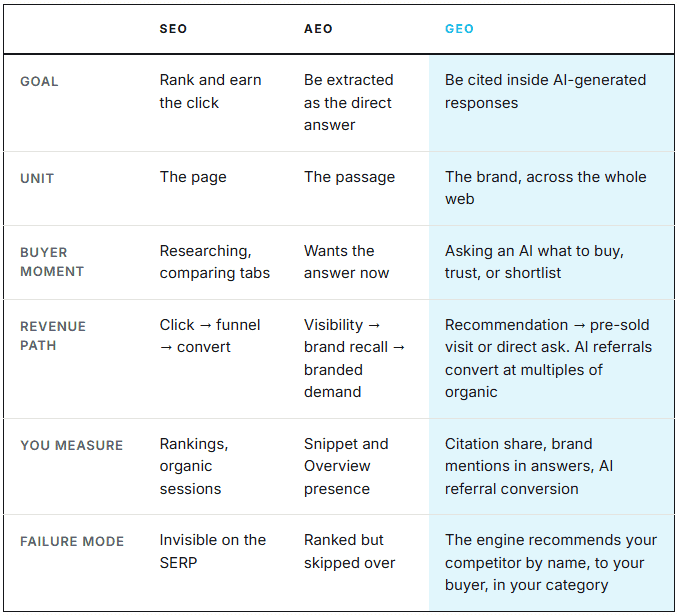
SEO earns the ranking and the click. AEO (Answer Engine Optimization) structures content so it can be extracted as the direct answer. GEO (Generative Engine Optimization) earns your brand a citation inside AI-generated responses from ChatGPT, Claude, Perplexity, and Google AI Overviews. Same foundation, different surface. The buyer increasingly decides on that last surface without ever clicking.
For twenty years, search marketing had one scoreboard. Rank on page one, win the click, run the funnel. That scoreboard still exists. It just stopped being where the decision happens.
Industry tracking now puts roughly 93% of AI search sessions ending without a single website click. Google’s AI Overviews appear on about a quarter of all searches, nearly double their share from a year earlier. And when an AI engine does send a visitor, that visitor behaves nothing like an organic one. Ahrefs measured AI-referred visitors converting at roughly 23 times the rate of organic visitors: half a percent of traffic producing 12% of signups.
Read that again. The smallest channel on your analytics dashboard is producing the most qualified buyers you have. That is not a traffic story. That is a revenue story hiding inside a rounding error.
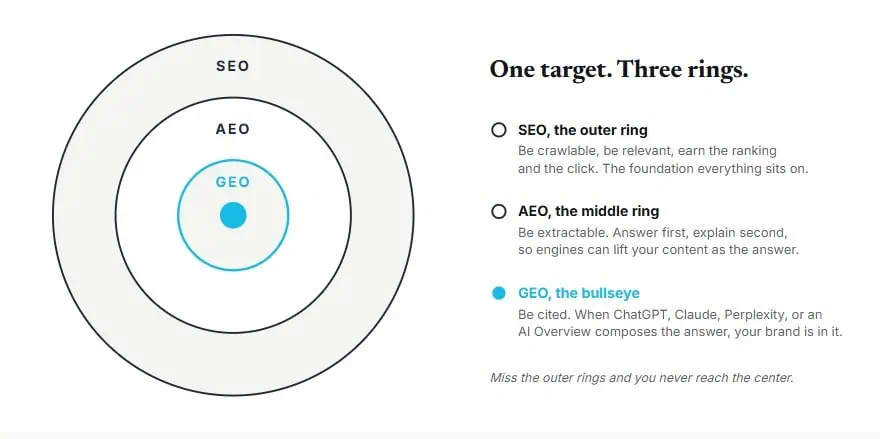
Figure 1. SEO, AEO, and GEO are layers of one discipline, not competing strategies. The foundation has not changed. The scoreboard has. © Bullzeye Media Marketing, free to embed with credit.
What each term actually means
SEO: earn the ranking
Search Engine Optimization is the practice of making your site crawlable, relevant, and authoritative enough to rank in search results and earn the click. Technical health, content that matches intent, links and mentions that build trust. None of this is obsolete. AI engines retrieve sources through infrastructure that looks a lot like search, so a site that fails at SEO fails everywhere else too.
AEO: be the answer
Answer Engine Optimization structures content so a system can extract it as a direct answer, whether that system is a featured snippet, an AI Overview, or a chat engine. The unit of competition shrinks from the page to the passage. The question stops being “can I rank for this keyword” and becomes “can a machine lift my paragraph and present it as the answer, with confidence.”
The most common failure is burying the answer. Content that warms up, contextualizes, and then concludes is content an engine skips. Answer first. Expand second. You are reading an article built that way right now.
GEO: be the citation
Generative Engine Optimization is the discipline of getting your brand cited and surfaced inside AI-generated answers across ChatGPT, Claude, Perplexity, Gemini, and Google AI Overviews, rather than just ranking on a results page. The term comes out of academic research from Princeton and Georgia Tech, which found that content carrying statistics, citations, and quotations earned materially higher visibility in generative answers, with lifts in the 30 to 40 percent range for some methods.
That finding is the whole game in one sentence. Engines cite evidence. They do not cite adjectives.
A citation does not always come with a link. Being named inside the answer, at the moment of choice, is the new shelf placement. You are either on the shelf or you are invisible.
The side-by-side
The numbers a CMO should actually care about
Skip the vanity layer. Four data points carry the argument.
One more, because it kills a lazy assumption. ChatGPT is no longer the whole channel. In Goodie’s 2026 B2B tracking, ChatGPT’s share of measurable AI referrals fell to about 63%, with Claude near 19%, Gemini near 11%, and Perplexity at 7%. Each engine retrieves and cites differently. A GEO program built for one engine in 2025 now misses a third of the channel. The fix is not five strategies. It is one source-of-truth content architecture that every engine can retrieve, plus per-engine measurement.
This is a revenue question, not a traffic question
Here is where most coverage of this topic goes soft. It treats GEO as a visibility project and stops at impressions. Impressions are motion. Motion is not the outcome.
The outcome is this: when your buyer asks an AI engine “what is the best clinical-grade imaging platform” or “which DTC skincare brand actually works for rosacea,” a brand gets named. The visitor who arrives from that recommendation is pre-sold, which is exactly why the conversion multiples are so violent. They did not find you. They were told about you by something they trust.
That reframes the budget conversation. SEO competes for attention. GEO competes for trust, delegated to a machine. And trust is built from evidence: original data, named expertise, verifiable claims, and third-party validation the engines can find. A bold claim with nothing under it is worse than useless here, because an engine that quotes your overclaim attaches it to your brand at scale. In AI search, a credibility leak compounds.
The Bullzeye playbook: Differentiate, Disrupt, Dominate
We run GEO through the same Bullzeye 3D framework we run growth strategy through, because it maps cleanly onto how engines decide what to cite.
1. Differentiate: say something only you can say
Engines are allergic to commodity content. An article that says what twenty other articles say earns zero citations, human or machine. The citable asset is the thing only you have: your proprietary data, your client outcomes, your named point of view, your founder’s contrarian take with receipts. Audit your content for one question: what here could not have been written by a competitor? If the answer is nothing, the engine has no reason to choose you.
2. Disrupt: restructure for extraction
Then make the differentiated thing machine-liftable. Direct answer blocks at the top of every page. Headings that mirror the questions buyers actually ask engines. Statistics with sources at point of claim. Accurate schema, not schema spam. Fresh timestamps that mean something: pages updated within two months earn roughly 28% more citations than stale ones. And a site fast and stable enough that aggressive AI crawlers do not give up and move on.
3. Dominate: build authority beyond your own site
Engines triangulate. They weigh what the wider web says about you: industry publications, analyst mentions, community discussion, third-party reviews, the places models already trust. This is the part on-page work cannot fake and the part most programs skip because it is slow. It is also where the moat is, precisely because it is slow. Earned authority compounds, and a competitor cannot buy it on a deadline.
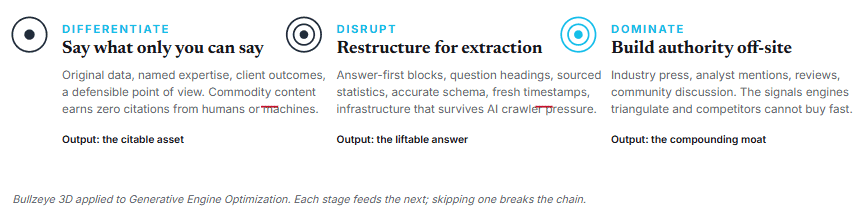
Figure 2. The Bullzeye 3D framework (Differentiate, Disrupt, Dominate) applied to GEO. The order matters: extraction work on commodity content amplifies nothing.
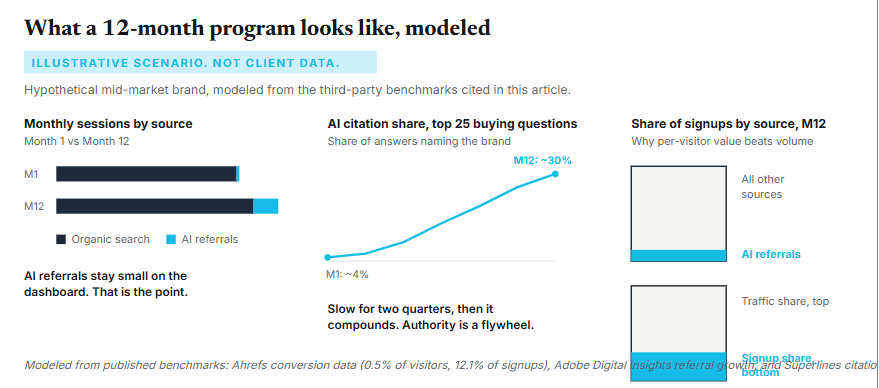
Figure 3. A modeled 12-month scenario, clearly labeled as illustrative. The shape to internalize: AI referral volume stays small while its share of conversions outgrows it, and citation share compounds after a slow start. We publish modeled scenarios as modeled scenarios. When we publish client results, they are audited and named.
The register changes by vertical. Respect that.
One thing the generic guides will not tell you: GEO is not vertical-neutral, because trust is not vertical-neutral. We run two very different programs depending on the lane.
Win the recommendation
The buyer asks the engine “best X for Y” and acts on the answer. Comparison pages, honest “vs” content, specific use-case answers, and visible third-party proof (reviews, UGC, press) are what get retrieved. Comparison and “best” formats drive the highest AI traffic, and engines reward specificity over slogans.
Move fast here. Adobe’s 693% holiday surge says consumer behavior has already shifted. Every quarter you wait, an engine is learning to recommend someone else.
Win on verifiability
Here the temperature drops and the stakes rise. Engines surface healthcare answers cautiously, and so should you. The citable assets are clinical evidence, peer-reviewed publications, regulatory clarity, and named clinical expertise. Every claim must hold exactly as written, because an AI engine repeating an overclaim about a medical product is a compliance event, not a marketing win.
Credibility is the strategy. In this lane, trust is what produces the revenue, and a single unverifiable claim can cost you the citation across every engine at once.
What does not work
Schema spam. Markup that does not match the content confuses engines and can suppress you. Accurate and minimal beats exhaustive and wrong.
Cargo-cult tactics. An llms.txt file on top of weak content changes nothing. Tactics amplify substance. They do not replace it.
Volume plays. Publishing fifty AI-written posts a month is the fastest way to teach every engine that your domain is noise. Citation share rewards depth per topic, not posts per month.
Optimizing for one engine. The channel fragmented. Build once for retrieval, measure per engine.
Reporting impressions as wins. The metrics that matter are citation share in your category’s buying questions, branded search lift, and conversion of AI-referred sessions. Everything else is motion.
Questions we get from CMOs
Does GEO replace SEO?
No. Engines retrieve through search-like infrastructure, so SEO failures become GEO failures automatically. Think of GEO as SEO extended to a new surface, where the answer is composed for the buyer instead of listed for them.
The AI traffic on my dashboard is tiny. Why fund this now?
Because the value per visitor is disproportionate (Ahrefs’ 23x conversion finding) and the channel compounds monthly. Citation authority is slow to build and slow to lose. The brands earning citations now are setting defaults the engines will keep recommending. Waiting for the volume to look respectable means entering after the shelf is stocked.
How do we measure GEO?
Track citation share: how often your brand appears in AI answers to your category’s top buying questions, measured across ChatGPT, Claude, Perplexity, Gemini, and AI Overviews. Pair it with AI referral sessions and their conversion rate, and with branded search lift, which captures the unlinked mentions analytics cannot see.
Is GEO different for regulated industries like healthcare?
Materially. Engines treat health claims cautiously, and verifiability becomes the dominant ranking signal. Clinical evidence, regulatory clarity, and named expertise earn citations. Promotional language does not, and overclaims carry compliance risk once an engine starts repeating them.
How fast does this move?
Fast enough that this article carries a date. The engine share data shifted by double digits inside twelve months, and ChatGPT’s in-answer brand links arrived overnight in May 2026 and moved referral traffic by triple digits in a week. Build the durable assets (evidence, structure, authority) and review the tactics quarterly.
Ask the engines about your category. See who they name.
We run your top 25 buying questions across ChatGPT, Claude, Perplexity, and Google AI Overviews, score your citation share against competitors, and hand you the gap analysis: what holds, what breaks, what to fix first. Built for DTC, MedTech, and healthcare brands where being the answer is the difference between pipeline and invisibility.